A short documentary about Bill Saxton, a veteran saxophonist and his intimate Jazz Club in Harlem, USA called Bill’s Place.
Bill was born and brought up in Harlem before his family moved to the East Village. After many decades, he returned to his neighborhood and opened an intimate Jazz club called Bill’s Place at 148 West 133rd Street, in a charming little brownstone apartment. Little did he know that this little brownstone, that can sit no more than 25 people, kept untold secrets and unheard musical notes hidden within its walls.
During the 1920s prohibition era, Harlem’s Jazz reigned supreme. In this musically rich period, a famous speakeasy joint known as Tilly’s Chicken Shack attracted singers and performers and dancers from all over, and it was in same brownstone building where Bill’s Place stands today.
This is the place where Billie Holiday and Fats Waller first performed during their early days. Bill shares this rich history of the golden era of Jazz and swing with his patrons that that flock to this place every Friday.
Shot and edited by Indrani Kopal
MFA Graduate Student ~ Documentary Studies and Production
Hofstra University School of Communication
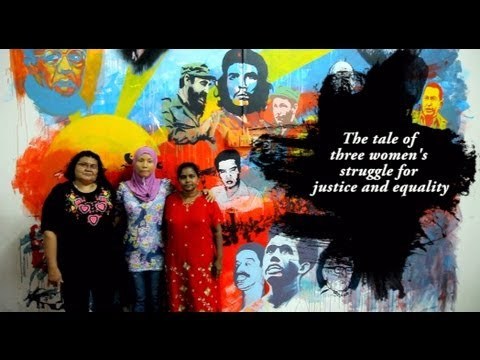
The tale of three women's struggle for justice and equality by Indrani Kopal | 12:05PM May 24, 2012
Guppy Union was started by women workers who worked in a plastics factory in Balakong, Cheras.
Their struggle and desire to start a union started 14 years ago, when they were frustrated with their bosses for increasing their wages by a mere 10 sen.
The workers then decided to get organised to protect their interests.
The first meeting to establish a pro-tem committee was held on Nov 16, 1997.
After much hassle, the government approved the Guppy Industries Workers Union on April 2, 1998, led by a seven-member committee with Koyil Vani Saminathan as chairperson.
However, Guppy refused to recognise the union unless three-quarters of the workers joined the union, including those in the branch in Prai, Penang.
The union committee and members were left frustrated as they had not been aware of the Prai operations.
Still, the three main office-bearers - Koyil Vani Saminathan, secretary Roshamiza Muhamamd and treasurer Kanniamah Annasamy - headed for Prai to recruit members.
In spite of numerous threats, negative propaganda and dirty tricks by the factory owners to deter union activities, they were able to slowly add to the membership.
On May 30, 1998, however, the management suspended all the committee members and then sacked Koyil Vani, Roshamiza, who had worked for the company since April 1993, and Kanniamah, an employee since July 1991.
However, the 200 union members re-elected Koyil Vani as their chairperson up to 2008.
The union continued to function under the able leadership of vice-chairperson Rahiman Mansor and assistant treasurer S Visaletchumy. But on Aug 25, 2001, they were suspended and eventually sacked.
Guppy Plastic Industries rejected all attempts by Industrial Relations officers to reinstate the workers or to agree to resolve any of the disputes referred by the union.
In September 1998, the matter was referred to the Industrial Court. In May 2006, the union lost the case, but took it to the High Court two months later. In 2009, victory was theirs.
However, the unhappy company appealed in October 2011, leading to a verdict in its favour on Feb 21, 2012.
Under Koyil Vani, the union had also championed a gender discrimination case for 11 years against the management.
In June 2001, 30 women workers above the age of 50 were forced to retire after a new handbook of employment regulations was introduced by the company, in which the retirement age was stipulated.
Eight of them filed a complaint with the Industrial Court. In 2008, it decided in their favour, finding that the difference in retirement age constitutes gender discrimination.
Guppy Plastic Industries sought a review and in 2010, the High Court overturned the decision.
The eight then filed an appeal, but this was dismissed by the Court of Appeal on March 21, 2012 in a unanimous decision by a three-member bench.
Justice KN Segara said the company was merely following its own employment regulations and that it is the industry norm to have different retirement ages.
For 14 years, these women had battled double oppression, for being women and for being a union member, in a country that is signatory to the UN Convention on the Elimination of all Forms of Discrimination Against Women.
For close to half a decade, the name of Daud Bukit Abal (Mat Daud Che Mat) was synonymous with the Dikir Barat tradition of his native state of Kelantan.
Born in the Pasir Putih district of Kelantan, his interest in Dikir began in light hearted fashion, imitating famous Dikir masters of his time. His deep and melodious voice however made him an increasingly popular singer, and he eventually emerged as a leading Tok Jogho.
Since 1961, when he made his debut, through the 1970's and 1980's, and till he was declared and granted the title Master of the Dikir Barat by his contemporaries in 2006, he ensured the ascendency of the Dikir tradition in Kelantan. As other traditional art forms in Kelantan were proscribed by the PAS led state government, Daud Bukit Abal further widened the platform of Dikir to embrace musicians and artists from these other 'outlawed' traditions.
In 2005, when there were suggestions that Dikir Barat, too, be proscribed and brought within the 'reins of control', he, along with other renowned Dikir performers, put up a formidable protest which led to state authorities rescinding their decision.
Along with the other renowned Tok Jogho, the late Salleh Jambu and the legendary Tukang Karut, Seman Wau Bulan (composer of the legendary Dikir song, Wau Bulan), Daud Bukit Abal ensured the expansion of the Dikir Barat by experimenting with style and new mediums of performance. Still, it was always the deep grain of his voice which left audiences "entranced."
He remained active, performing, teaching and ensuring the transmission of Dikir to a younger generation of performers till his passing on 17.09.2011, so that every contemporary performer of Dikir can trace his lineage to Daud Bukit Abal whom they, and the vast Dikir audience in Kelantan and elsewhere, still embrace, with the deepest veneration, as 'The Godfather of Dikir Barat.' - Eddin Khoo (Pusaka)
Since 2008, Daniya Subramaniam, a young dog rescuer has rescued and re-homed more than 200 dogs and 30 cats through her friends and network on Facebook.
Like Daniya, there are many other independent animal rescuers who have a day job like everyone else but spends most of their spare time and savings rescuing homeless, stray and abused animals from cruel authorities and animal abusers.
They bathe, feed, provide them with shelters and above all, they give them love and heal them from the fear and pain of having been abused.
Like Daniya, another rescuer from Kajang, Puspha Rani, a young mother of two, has been rescuing many unfortunate stray, injured and sick mongrels. She spends a fortune spaying, neutering, vaccinating them for years.
What drives them? What moves them to halt at highways and dash across the street to rescue an injured puppy? What makes them work twice as hard just to feed homeless animals? What motivates them to drive for miles daily to feed neglected dogs on farms? How do they maintain a normalcy in life doing extraordinarily self-sacrificing gestures for the sake of extending some sense of normalcy to the creatures of earth?
This an extraordinary story of two ordinary girls doing extraordinary work.
If you would like to help or contribute these two ladies to ease their burden, kindly contact them at:
Contact details:
Daniya (012 969 9194)
https://www.facebook.com/profile.php?id=1351070389
Video: The people's voice The usage of video in grassroots journalism
Celebrating the spirit of civic activism and taking user generated content to new level, Malaysiakini has introduced Citizen Journalism Malaysia (CJMY).
The program provides basic news reporting & video production and usage training to users so they can use the power of media to raise issues that matter to them and issues that has been neglected by the mainstream media.
It is a program that empowers volunteers to help their own community by using single point-and-shoot video cameras to capture their stories on video.
The video highlights the use of participatory video and new media as an advocacy tool by ordinary citizens, and the changes it has brought into the political and social climate in Malaysia.
In September 2010, Wei-ling Gallery presented Anurendra Jegadeva's much-awaited solo exhibition entitled 'MY GOD IS MY TRUCK - Heroic Portraiture from the Far Side of Paradise'.
For those who missed it, Malaysiakini.tv presents you with an overview of the remarkable artwork with an exclusive interview with the artist himself plus additional interviews with cultural activist Eddin Khoo, academician Farish Noor and the gallery director, Wei Ling.
BATU ARANG MERDEKA SPECIAL | A step back in time
Produced by Indrani Kopal | Sept 18, 2010
The quiet Batu Arang is home town of former All Malaya Estate Staff Union secretary-general Jiwi Kathiyah.
According to Jiwi, during its heyday, Batu Arang was a fountain of peace and a cauldron of revolutionary spirit, all at the same time.
Batu Arang was the birthplace of many radical unions. The Coal Workers Union had a leading role in some of the largest strikes of the period when they protested over their working conditions and poor wages.
This forgotten town which witnessed some of country's most popular labour strikes and demonstrations is also home to many prominent leaders past and present. Today it silently holds many untold stories of our history.
Batu Arang has seen its ups and downs. But this little town, though it looks a bit tired, still retains its beauty.
Or forty one homes … not houses … homes. Forty one families. Hundreds of lives.
41 families are all that is left of the once vibrant community of Bukit Jalil Estate. They know they cannot remain. Some of them who remain once worked in the estate.
They have been there for 70-over years. They have laboured and contributed to national development for meagre wages. Many have passed on and to take their places are their children and grandchildren. What they want is fair and equitable compensation for the toil.
For the years of low wages. For their contribution to 53 years of national development.
10-min (Screening Version)
Documentary
July 8, 2010 | New York City, USA
Film by Indrani Kopal (Malaysia) and Simon De Swardt (Zimbabwe)
This documentary was produced as part of a documentary Fellowship programme of the George Washington University documentary centre. The programme is the 2010 International Emerging Documentary Filmmakers Fellowship.
The short documentary titled 'I only dance for you' is a slice of life story, about a gay couple who live in Greenwich Village, New York City. Arsenio Amadis and Don Swift, opened their doors and lives to the two emerging international filmmakers.